
It’s a 7 am start for a packed day of Egyptology on the West Bank of the Nile. Our fixer at the Princess Hotel in Luxor, Jak, surprises us by providing an air-conditioned mini-van just for Christi and I. Based on prior experiences with tours in Egypt this may not prove to be the case. We double-check with Jak. A private tour of Deir al-Bahri, the Valley of the Kings, and Medinet Habu – guaranteed, he assures us. I like this guy (check him out at Jak_Jak240@hotmail.com if you need a fixer in Luxor). Our driver / guide is Sassa. He is polite and drives very carefully. He prides himself on never having had an accident with tourists (I guess this is a good thing, but what does this say about the other drivers?). We follow the course of the Nile downstream until we reach a heavily guarded bridge across the river. Egypt does take its security very seriously. Perhaps too seriously and maybe this contributed to the Arab Spring. Having said that our first destination, the funerary temple of Hatshepsut (Deir al-Bahri) has seen its fair share of troubles. In 1997, 62 people (men, women, and children) and many of them tourists were killed here by Islamist terrorists. Indeed, Egypt is enduring a two-decade long fight against terrorist activities. But on this hot morning with brilliant blue skies, Deir al-Bahri is at peace. This will not last long as hordes of tourists will be bussed in throughout the day. I take this opportunity to photograph the funerary temple of Hatshepsut, tourist-free.
Set against a backdrop of the Theban Hills, Deir al-Bahri stands as a magnificent mausoleum to perhaps the most powerful woman in history (certainly more so than Cleopatra and Margaret Thatcher). Hatshepsut was a Pharaoh of the 18th dynasty, ruling between 1473-1458 BC. She ruled initially as regent with Tuthmosis III (her nephew and the rightful heir), but she usurped his authority and took over complete power. Surprisingly she did not kill off Tuthmosis III, which may have been a mistake because when he eventually ascended to the throne (after the death of his step-mother) he ordered that her statues be defaced and her body was even removed from her mausoleum. Hatshepsut’s body was only formally identified again in 2006. One could argue that the scandal in Ancient Egypt is on a par with modern-day Hollywood!
We leave Deir al-Bahri to the tourists and move on to our next stop, Medinet Habut. It’s 10 am, hot and the tourists are out in force. The central feature of this complex is the temple of Ramses III, which is the largest temple hereabouts after the temple of Karnak. Perhaps the most impressive aspect are the abundance of reliefs that still retain their original color. As usual one is not supposed to photograph these delicate antiquities, but the local officials are happy to turn a blind eye for an appropriate ‘backsheesh’ (tip). At this point with so many facts and figures spinning through our heads, not to mention the oppressive heat we find a shady restaurant with air-con and cold drinks to wait out the excessive heat of the day.
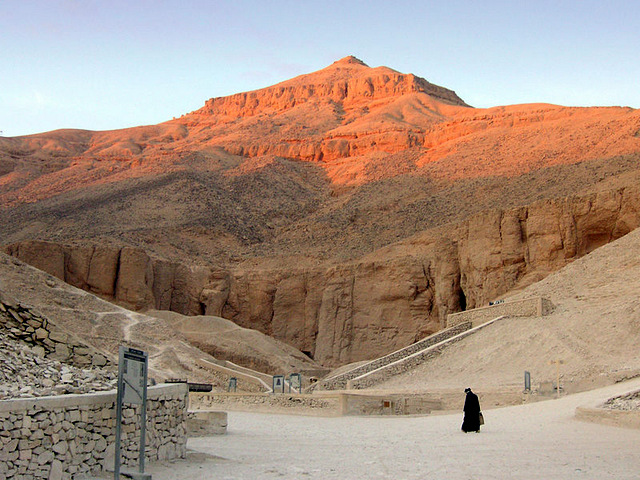
Our last destination is the Valley of the Kings, which was used for primary burials from approximately 1539 BC to 1075 BC encompassing the 18th to 20th dynasties of the New Kingdom. The Valley contains at least 63 tombs beginning with Thutmose I and ending with Ramses XI. The reason this Valley (an arid, dusty landscape) was chosen to house the tombs of the pharaohs are manifold: (1) It was not practicable to continue building bigger and better pyramids than those found in Giza. (2). Safety. Few people lived in the West Bank, therefore there was less chance of the tombs being looted (that didn’t really work out). (3). The sun set in the west – the death of the day. (4). The A pyramidal-shaped mountain, Al Qurn, (the sign of immortality) dominates the Theban Hills hereabouts, and (5) the extremely dry conditions would help preserve the tombs and their contents. Of course most of the tombs were looted in antiquity with the exception of that of Tutankhamun. We visit a few of the tombs, including Merneptah (the son of Ramses II) and Tutankhamun. The tomb of Merneptah is huge in comparison with the boy-king. The various decorated tunnels and ante-rooms culminate in the burial chamber for Merneptah, where his stone sarcophagus remains in place. The much smaller funeral chamber of Tutankhamun is marvelously decorated and best of all the boy-king’s mummified body remains in his red quartz sarcophagus.
We’re hot, our heads are swimming with too much Ancient Egyptian history, but it has been a wonderful day hanging out with Egypt’s Pharaohs. What wouldn’t they have given for an air-conditioner back in the day!




Blog post by Roderick Phillips, author of Weary Heart – a gut-wrenching tale of Love and test tubes.


Speak Your Mind